Project Overview
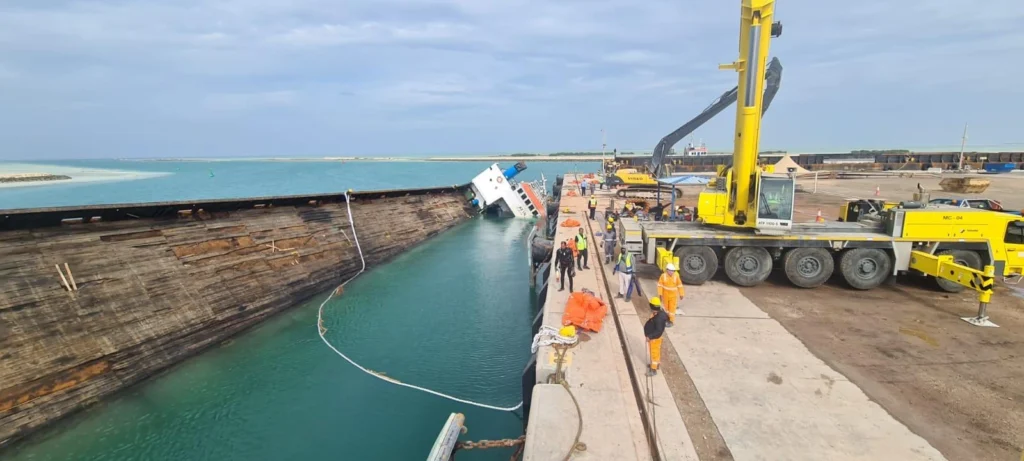
This project involved the salvage and recovery of the sunken cargo vessel SUPER-188, as documented in official marine records. The vessel was resting at a significant list inside the port area, requiring a carefully engineered recovery plan to ensure safe refloating without causing further structural damage.
The operation was executed using a controlled salvage methodology that combined debris removal, dewatering, heavy lifting, and buoyancy control. All recovery works were successfully completed within 13 working days, meeting operational safety standards and project time constraints.
Project Location
The project was carried out inside the port area and surrounding waters. Upon completion of the refloating phase, the vessel was relocated to a designated safe shelter area with controlled depth and suitable seabed conditions for inspection and repair.
Scope of Work
Removal of debris and remaining cargo from the vessel to reduce overall weight
Controlled dewatering of port-side tanks to gradually reduce the vessel’s inclination from approximately 60° to 30° or less
Progressive refloating of the vessel until the hull was fully buoyant and clear of the seabed
Deployment of marine cranes with lifting capacities of up to 350 tons at the aft and midship areas, and 250 tons at the bow
Utilization of the engine room, rear tanks, and selected port-side tanks to manage buoyancy and stability
Installation and operation of lifting air bags with different capacities for precise leveling control
Gradual stabilization of the vessel and safe release of lifting equipment once equilibrium was achieved
Comprehensive underwater inspection of the hull, bottom, propellers, rudder, bow, sea strainers, sacrificial anodes, corrosion condition, and hull plate thickness at selected locations
Controlled relocation of the vessel to a safe shelter area following technical assessment
Preparation for repair activities, including replacement of corroded deck plates


